Wasn’t it ‘keep it simple, stupid’?
both exist, simple is the “official” one. I prefer the sexy one. Hey, I used Xojo, I think different 
1 Like
Berk! 
Is there anything palatable that carries that name?
How much is it used in-country these days? I’m 50% Luxembourgish (my Dad’s side of the family) and he used to tell me when he was a kid the “old timers” still spoke it among themselves (Chicago, IL area). As a child he understood it, but did not speak or read/write it.
Most Luxembourgish immigrants to the US, or at least to that part of the US, were farmers, but there were a few entrepreneurs – there was in that area at one time a Grommes Dairy, and a Grommes Amplifier company (valve amplifiers for guitars). My forebears were farmers; my Dad grew up on a farm but became a master auto mechanic and switched over to aircraft when auto mechanics was commoditized. From what I hear, in-country, the joke is you’re either a farmer or a banker  but I’m sure that’s some kind of stereotype.
2 Likes
keep it stupid simpleton ?
Wow! “Moien Bob” (if you know that one).
Our population is around 640k (fun fact it was 270k when I was at school) and roughly 78% speak Luxembourgish. But I would say only some 50% are native speakers and speak it fluently (the country is doing quite a good job by gently forcing foreigners and refugees to learn the language). It still surprises me to enter a Chinese restaurant and the owner is fluent in Luxembourgish, because when I was a child all Italian restaurants owners for instance spoke French only.
I remember when I was a child some 45 years ago that almost half of the population migrated to the US in the late 1800’s early 1900’s and they showed on TV interviews with American “Luxembourgians” and the generation of your Dad were often still quite fluent in the language and they showed some communities cooking Luxembourgian dishes etc.
Fun fact is that people in Luxembourg are acting like a good old accustic modem for a few seconds to find out what is the best common language (French, German, Luxemburgish, or English).
It is not really a stereotype. The south of the country had a lot of steel industry (the old World Trade Center had Luxembourgish steel), all that industry is gone now, and the north was always sparsely populated, still suffering badly from the Rundstedt offensive at the end of WWII and remaining very firmly in the hands of Farmers after the war. In the south, where the capital is, came the banks, software industry, etc. Only about 20 years ago, an expressway to the north was built (before you had to drive north via Belgium ), so that the situation is now changing year by year, but very slowly. But many Farmers are now doing more tourism than real farming …
1 Like
1 Like
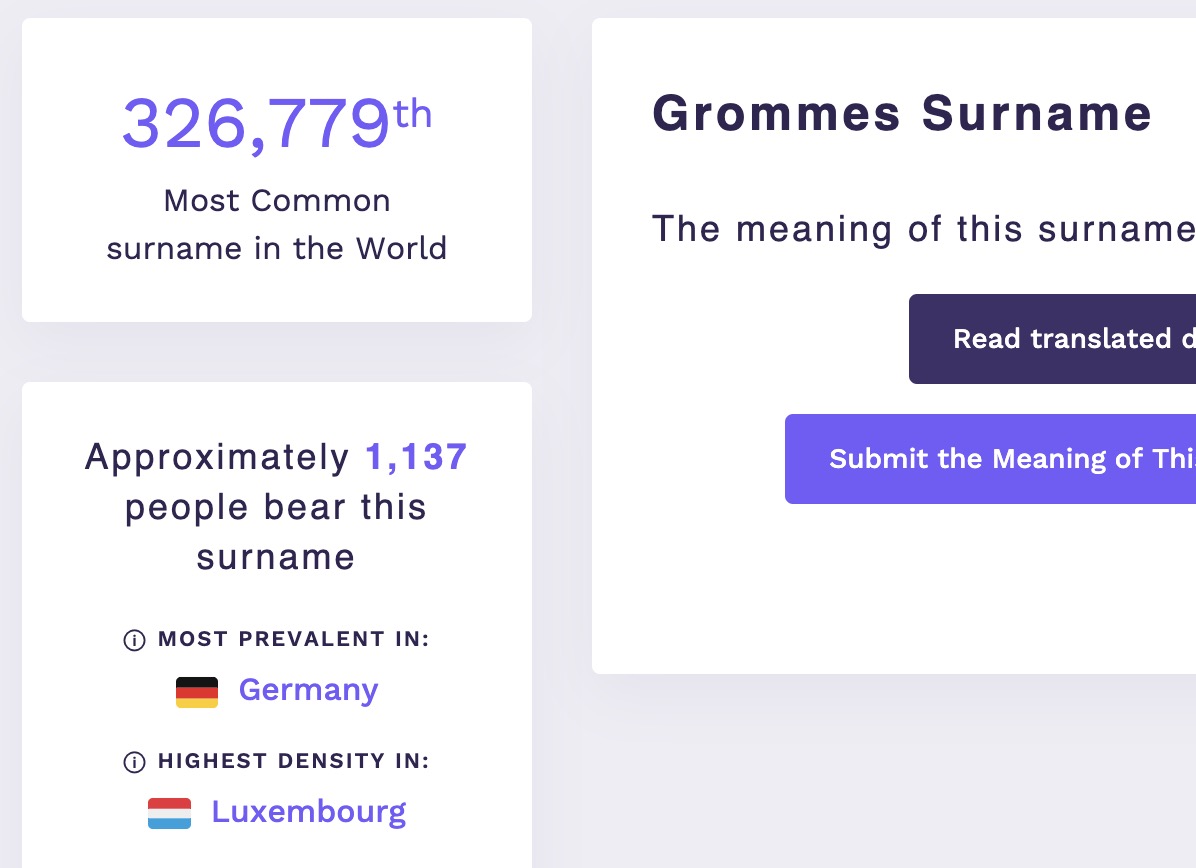
“The meaning of the surname is not listed”.
I have searched in vain for an origin story or meaning for the name. Most Grommes-folk are in Luxembourg, fewer over the border in Germany, and then the US diaspora, with a concentration in northern Illinois.
I once asked a German client if he had any idea and he was one of those guys who can’t admit he doesn’t know something so he fumbled around Gros = large but clearly wasn’t sure.
I’ve gotten used to it being lost in the mists of time.
My Luxembourgish ancestors landed in the Chicago area around 1835. So they must have been the vanguard. Do you know if there was a major reason for the exodus?
It is hard to exactly trace, geneologically, because certain common names were used over and over, like John. Same problem on the maternal / Swedish side of the family. Which Jon Carlson are we talking about? It’s not always clear.
Good to know the mother tongue is still hanging on.
For my part, all I know is that I’m a little Fritsch.
I dearly wish they had stuck with that. But it’s the least of their problems now.
2 Likes
The desire to distance themselves from BASIC was a big motivation
They should have just owned it and left that well enough alone and pursued a marketing campaign
This is not your fathers Basic
But its all water under the bridge now

Ask him for 1835 when he just woke up, he may feel then like born in 1835
But to trace that it is really complex while not all documents are known, not all places are even known and so it is extremely complex.
Tracing history is tough when documents are missing
We can trace our history in Canada back a long way (1635 or so) but once it moves to France there’s nothing we can find as so much was destroyed during the wars
1 Like
Wikipedia has an article about European emigration. Luxembourg and Switzerland were remote rural areas with many people living in poverty. Poverty and the quest for a better live was the primary motivation for emigration. Coincidentally, Luxembourg and Switzerland have the highest per capita incomes of all countries in Europe today.
1 Like
Exactly. 1817 was in Luxembourg (and Europe) a year of famine and the first year of a massive emigration. In the 1820s the situation improved slightly, only craftsmen have emigrated to South America.
From 1830 to 1890 (death of the Dutch King Wilhelm III, who was also ruler of Luxembourg) there was very little industrialization in Luxembourg, we were regularly collateral damage from our neighbors’ wars and a political pawn. That was the peak of the wave of emigration to the United States.
After 1890 and the beginning of industrialization in Luxembourg, and since the country was fully independent for the first time, emigration stopped very quickly until both world wars.
“Grommes” could back to the family name “Grundmann”. Grundmann is a personalized dwelling name: That was what someone was called who lived near the bottom of a valley or a ravine.
“Grund” = ground
“Mann” = man
And “Grommes” could be a trivialization of “Grundmann”. This explanation sounds very logical because there are other names where this is proven, but unfortunately not with your name.
So Grommes is either like REALBasic or meaningless like XOJO
Today there are still many Luxembourgians who talk about the fact that there are more Luxembourgians in the USA than in Europe. That may be true, because many were Catholics and diligently reproduced without the pill.
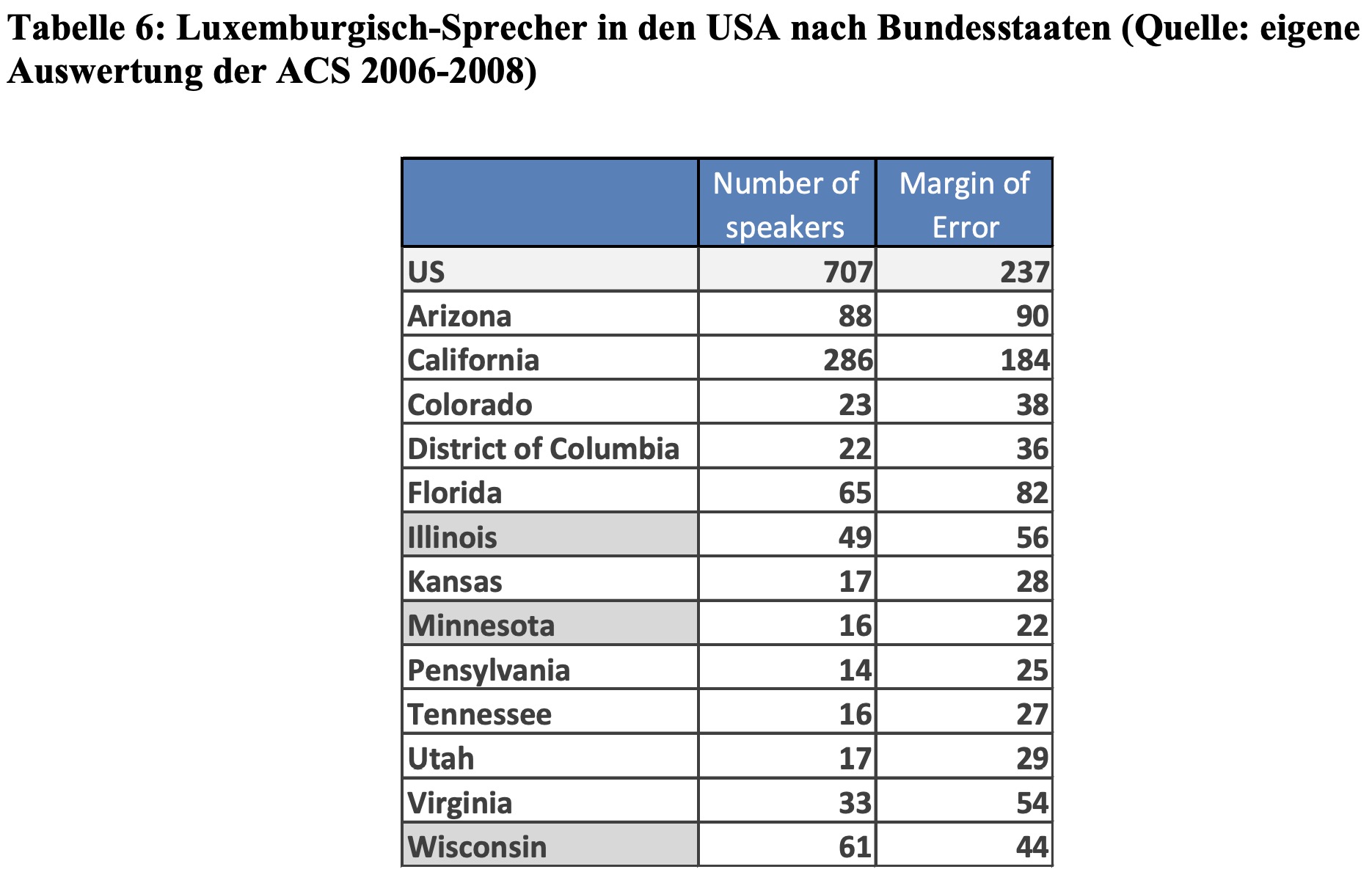
But purely factually, almost nobody speaks Luxembourgian in the USA anymore, which is absolutely logical, and it’s not much different with German either.
1 Like
I could have written that in the stable genius style:
I was born in 1970, after which all citizens understood that there were no more reasons to emigrate to America and that the future of the country was bright.

MOSELFRÄNKISCHER DIALEKT 
Like it or not since 1984 it is an official language by its own and recognized by the UN and the EU.
Since 1984 Luxembourgish has been officially recognised as the national language of the Luxembourgers. Incomers realise the eminently practical value of this language in their contacts with the locals: it makes it easier to get into conversation with people, to get to know them and break the ice.
https://www.europarl.europa.eu/language/apprendrelu_en.htm
And here’s something to convince you, by the way, I’m not aware of any Xojo interest group in Luxembourg.
Funny side effect: in the same year, i.e. 1984, I had to learn Luxembourgish for a year at school and the exam consisted solely in memorizing the national anthem and writing it down
Oh I like that. It is needed and it is part of your culture. And, by the way, this moselfränkisch is the former dialect spoken in the entire region for hundreds of years and out of this luxemburgisch was “born”. It was not negative when I said that. And yes, I like that much. It is a nice “Sprach”
1 Like