Is Xojo worth buying in 2025 for cross-platform, hobbyist, desktop development? And if not, what is (free or cheap)?

As an occasional, hobbyist programmer, I grew up with Basic variants in Windows, such as Visual Basic and RapidQ, but transitioned away from the Windows world and into the Linux a few years ago, only running Windows very occasionally in a VM. I never regretted that move, but it did leave me “homeless” with regard to programming languages, and I realize that most of the world will probably stay with Windows.

So I am looking for a free or affordable programming language that compiles for Windows and Linux, is actively developed, has an active user base and forum, includes an IDE with “RAD” and a form designer, and with a language that is intuitive, even for the occasional coder (which is why I like verbose languages in the Basic family). So far I am using PureBasic, which is awesome, very affordable and close to perfect for me, but not object-oriented and not very “RAD” in it’s approach. I have also looked at FreeBasic (looks nice, but seems complicated for creating cross-platform GUIs), FreePascal/Lazarus (very nice IDE, but I don’t like the Pascal language much) and B4J (seems complicated to set up on Linux with Wine).

Xojo also looks appealing, with its very intuitive, object-oriented, Basic-like approach, so I was considering buying a license for Xojo during the recent Black Friday sale, but ultimately decided against it. The steep price and debates in this forum make Xojo seem like a dying language to me. I could perhaps spend the USD 400 on a one-time purchase of Xojo, if I knew the product were thriving - or if the license at least didn’t rely on license servers remaining operational in the future, no matter what PC I use.

But maybe I am just being silly and should get Xojo? Or is there something more appropriate out there (cross-platform, affordable, Basic-like IDE/RAD and not “dead”)?

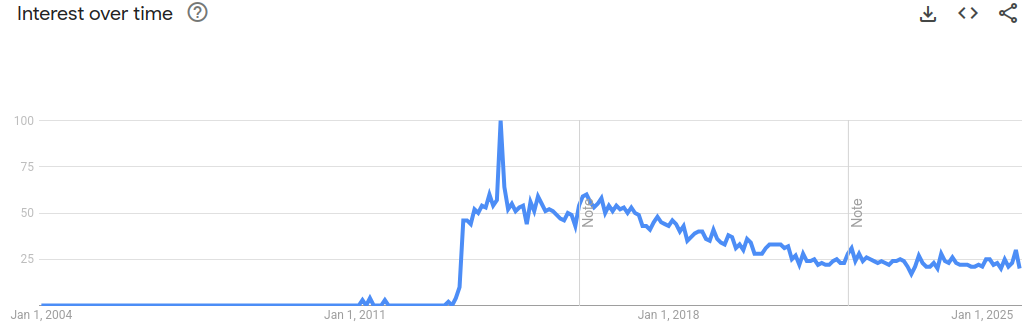
This is what Google Trends shows about Xojo searches:
This is my PERSONAL OPINION

Xojo is NOT worth the time and effort (or the money involved) for a few reasons

  1. it has many many bugs, most of which have been well documented and have languished for years due to the incorrect assumption that more bells and whistles are needed (which just of course adds to the problems)

  2. The attitude of the management of the company that belittles that attempted contributions from its dwindling community, and waffles between “Pro developers are not our audience” to “Newbies are not our audience”, making it impossible for them to find any real audience at all.

  3. They process of reducing problems and complaints by simply banning those people making them, which in turn has driven a substantial number of power users to find other tools that fit their need (I for example started with Xojo in 2006, left in 2019 and have been using Swift 100% ever since)

  4. There are plenty of alternative tools some are platform agnostic (Swift for Apple for example) while others are truly cross platform (Java for example)

And on the topic of “Cross Platform”, regardless of their advertising, Xojo IS NOT CROSS PLATFORM it is *Muliplatform” at best (and they don’t even do that well), A “cross platform” tool would be able to compile from a single code base for macOS, Windows, iOS, Linux etc. where instead you need a unique project file for each.

So is the product “thriving”… uh..NO… And being a subscription model, you can use it for as long as you like, but any updates, fixes (when they rarely occur) would not be included

1 Like

You are much better off staying with Purebasic. I’ve been using for a few years now.

1 Like

The words “looks appealing”. That’s what I thought too. You’ll be very happy at first, maybe for a while. It didn’t used to be that way, but when iOS and Android were added things got worse.

I tried to use Xojo as a FileMaker replacement. I spent a lot of time trying to make it work. I moved to PHP and all my problems went away. I haven’t run into a bug yet!

That said, if you have the cash and are ok with workarounds, go for it… I would not otherwise.

Xojo - it is what it is :wink:
Far from perfect, but also not bad (depending on the use case).

Quite ok for (cross platform) Desktop applications, as long as you don’t expect to leverage all the newest/fancy stuff every OS includes. Web is quite ok, too. But I don’t use any Mobile targets.

As far as I know it’s free to use (and build) on Linux - so just go ahead and try it.
You then can also just debug-run on Windows to see how’s it going for you on that platform.
Should you be happy with what you get and see you can consider if it’s worth getting a licence to build for Windows, too.

1 Like

I’ve spent the last hour drafting different forms of this post… all I can say publicly is:

No.

6 Likes

Xojo is dying. Slowly but surely. With Xojo you will spend a lot of time working around never-fixed bugs and missing features. And you will pay for being their unpaid beta-tester.

2 Likes

No, it is already dead. This is the funeral feast we enjoy now. If it would really be alive we would see more activity in taking c<re of Bugs.

2 Likes

Given the number of free and very inexpensive development environments out there I would be hard pressed to say yes. For personal use, sure, maybe. It costs nothing to use it in pure development mode and if you never have to create an executable then I guess that’s okay.

If this is for business/consumer use then the question is always ‘are you willing to bet your financial future on Xojo?’ If the answer is yes then sure. If you hesitate then the answer is a firm no. Bite the bullet and use one of the free tools.

For Windows and Linux I’d use Java or C#. I believe both languages are relatively easy to learn and there are a ton of resources to learn (unlike Xojo where there are practically none). Personally I’m a fan of Go (despite not being OO it is very OO-like and easy to learn) with Wails (any web front end you want like React, Svelte, Vue and others).

IMO, Xojo is already an irrelevant language. It once had great appeal but they’ve squandered whatever advantages they had in this space long ago by ignoring the pro’s that used it and more recently with the staggering price increases for hobbyists.

5 Likes

…but to be fair, you’re asking in a forum where the majority of members have already left Xojo behind, (even if one or two are obsessed with talking down a tool they claim not to use)

Xojo is not the future. And , like much in the desktop arena, has a limited lifespan.

But:

With Xojo you will spend a lot of time working around never-fixed bugs and missing features.

You know what? I don’t. I make a living from products made in Xojo, and since I don’t push the envelope, I don’t get as frustrated as others have been. (I know what their problems are, they are real, and complaints are justified. But you may not run into them. I haven’t)

I don’t know your age or your future plans. If they are long term, I agree with Bob.

If you know Basic / VB, you won’t get an app up and running faster than using Xojo. To me, the real shame is what they did by dropping the Lite licence, which was the ‘get newbies on board’ level.

Stupid.

4 Likes

Thanks, everyone. You have confirmed my thoughts about Xojo, and reduced my FOMO! I guess it ultimately comes down to the increased prices and seemingly dwindling community (and hence sustainability of Xojo), for me.

With my limited use case, I can’t really justify investing the time - and money - on Xojo, if it’s a dying tool, with bugs not being actively fixed and no guarantee that my license will work in the future, if Xojo goes bankrupt. Had the license been a reliably “offline” solution, or had the price been a couple of hundred dollars lower, I would probably have felt comfortable buying a license.

I agree that a Lite license would probably make sense commercially. If the Xojo language is indeed dying, Xojo would need an influx of newbies to turn the tide. You don’t get an influx of new users by hiking prices, especially not with so many good and cheaper alternatives out there.

Thanks again.

1 Like

You can download your license file and run it offline.

1 Like

in most cases that is possible but not in all cases. And it may come up a problem with several hardware changes without deactivation cause the license in license file may be blocked. There are several problems which would come up with the licensing

You may have got different opinions on the Xojo forum. And the question is how many existing projects in Xojo you may have to maintain.

Many projects left XoJo already. And more will follow. While there is no movement to a quality based releasing. The rapid release system is done. There is nonchalance to get back to the needed quality with it. That pushed away many pro developers. Keeney, Muller and more. They went to other languages and stopped their XoJo engagement. Not while they wanted. While there was no perspective for development for the future. And that makes using of a language in this case impossible.

Developers for commercial environments needing reliability, stability, code consistency. This three fundamental conditions must be fulfilled to be able to develop under industrial conditions. People like Muller, Kenny, Norman Pallardy got that fact cause they saw no future for their development purposes. Development today is too fast done with modern tools.

Also there is no user base anymore. That produces the next problems. Try to use AI. And then compare that use of AI with Python, Java, C++, C#. You will see that no AI is trained for XoJo. Even if they train an AI model for XoJo: it will always be far away behind trained models for other languages.

That makes development slower. As developer in Java and Rust I can say that I use AI for code completion and much boilerplate stuff. And it delivers. In the early stage it was not so. But in the meantime it is trained well enough. By millions of programmers. By millions of code examples delivered from the community. How shall this take its way in case of XoJo language? I have no Idea.

The entire problem is: XoJo isn’t reliable and it lost its given code consistency. I can understand that they wanted to drive it in the direction of one project for all. But I can see that it was not working like they wanted. And that makes headaches.

For example: while XoJo presented Android as alpha functionality (it is still early alpha compared with others like Flutter/Dart, CodenameOne, GluonMobile, Kotlin Multiplatform mobile and many others I was never using until now). For example: no tables with more than one column. Okay, let’s say without tables only with a list view. Other platforms presenting themself as full functional systems for iOS and Android. Simply for both. They are running without any problems compared to XoJo.

They missed all chances. For example: basing Android on kotlin gave the chance to have exactly one mobile project. Concentrating on that gave the chance to say: one mobile for all. Even with native GUI in Kotlin Multiplatform they could have that. But they decided: Android only. And that with limited functionality. Makes it impossible to write Software with it as real Multiplatform. See, we can share application logic. But we can’t share the rest. And we have to do it with copy and paste instead one project.

So you can see: the chance was there but not the capabilities. Makes XoJo to be a Death Valley. There is no way for a future in professional environments.

Why people still with XoJo? Simply. They have tons of sources written in XoJo and don’t want to change them, some while they want to retire in a few years and some while they have no Idea about and some others while they say: I don’t want to learn an entire new language. I can understand that. But the future is insecure. The only person which could change that is the CEO of XoJo. But also only with investing much money. And with increasing the development team to be able to get that work done.

I doubt that this will ever happen.

1 Like

There is a difference between what people WANT and what they NEED. And unfortunately people are greedy and emphasise their WANTS. Developers WANTED new features faster and clamoured for the Rapid Release Model (it was not as if it was only Geoff), but what they NEED is reliability. Things, and especially the Basics, just have to work. - and Rapid Release is detrimental to this and over time turns it into a beta quality product (even Apple noticed a decline in software quality when they changed their 18 month release cycle to 12 months). And THAT is what nobody understood even when you explained it to them because they didn’t WANT to see it this way. They thought they could get new features faster without sacrificing quality. But as the old saying goes: “You can have it fast, good quality, or cheap - pick any two”.

3 Likes

Yes, I know that fact, people want features even if they will never use them, Simple fact, true. But the decision behind was a decision by XoJo. The rapid Release model came while they have decided for and not while the users decided for. At the end this made development cheap enough and they could handle this with a few developers. But we can see that it is not working like expected at all. What ever: now we are in the situation that the product is like it is. With many bugs and half working fancy features. We can see now what this rapid release was bringing to the people.

I can also understand why doing it cause for the sales to new customers it is better to have more features. Nobody looks to deep inside when deciding for it cause: test project runs without any problem. That’s the problem behind. And the CEO was smart enough to recognice this fact. If even people making a concept and trying to get a working example of a bit of the functionality.

Xojo’s quality problems came well before the Rapid Release Model. Part of the reason why I joined the beta program (as it was named back then) was because a new feature was added and the example project didn’t even work as intended! The RRM just made the problem worse.

Xojo does not do code reviews. Xojo does enforce unit testing. They have no staff for regression testing before releasing and put that on pre-release users. Releases were calendar driven rather than feature complete and thorough testing. I mean, what could go wrong with all that?

Theoretically you could have a reasonable RRM that works. You have a major release than then have one or two bug releases and then rinse and repeat. But that’s not what we get and thus quality continues to be a problem and has gotten worse because there are more targets than ever and no increase in development staff.

5 Likes

Yes you could but that is always on the expense of more affort for quaity in release cycle. But that is something you need one thing: the will to do it. And this has a price cause it produces more workload for releasing in a better quality, testing, QA and so on. Something yu have no chsnce to do it having only 5 or 6 developers. That cuts your abilities to reach highe quality while there is not enough manpower.

And as many people mentioned before: it would not be the case if there would not be this big portion of new functionalities and platforms. That makes the product more complex and it makes more expense to get a usable quality.

On top we have also management fails which made it even more complex. For example messageBox. It was msgbox. And then messagebox. Why? Makes it any kind of difference? Has it some goods served to the customers like a new and better ApI? The answer is simple. NO. This kind of renamings producing stress for the customers while the api is changed. At the end: the related bugs got now bugs of old api and so there was a big amount of bugs now not active anymore.

Until the people resended the information of an old bug for new API. Instead if renaming a fixing would be a better idea.

Fails like that are not priceless. Paying is the user for it. Old Sourcecode which ran over a decade is now not running anymore and has to be rewritten. For what? Nobody knows really. It would have a nice effect when and if there would be the target of one project for all. But I can’t see that.

That’s true for the abandon users who are here. And to be honest it’s only a handful of the same spawning there frustration again and again and again and again.

That’s fine but it does mirror a one side opinion for sure. I guess asking the same thing on the official Xojo forum could be interesting.

2 Likes